Views: 0 Author: Site Editor Publish Time: 2025-08-05 Origin: Site


When I turn on my tap, I know there’s chlorine in my drinking water. In the U.S., safe chlorine levels range from 0.2 to 4.0 mg/L, following EPA and WHO guidelines. Here’s a quick look at chlorine ppm in drinking water:
Source/Region | Chlorine ppm (mg/L) | Notes |
|---|---|---|
EPA Max Allowable | Up to 4 | Safe for drinking |
WHO Recommendation | 0.2–0.5 | Disinfection, minimal health risks |
Typical U.S. Tap Water | 1–2 | Varies by region and system |
Why do we have chlorine and chloramine in our drinking water? They kill bacteria, viruses, and help disinfection. I sometimes notice a chemical taste or odor, especially when chlorine and chloramine levels change. Some friends don’t notice it at all. If you’re like me and want to remove chlorine, a water purifier can help. Disinfection keeps our health protected, but high chlorine levels or chloramine can affect taste, odor, and even pose health risks. Water purification or a water purifier can make a big difference in drinking water quality and effects.
Chlorine keeps tap water safe by killing harmful germs, with typical levels in the U.S. ranging from 0.2 to 4.0 mg/L, which meet EPA and WHO safety standards.
Chlorine levels vary due to water source, bacteria, seasons, and maintenance, affecting taste and odor but ensuring ongoing disinfection.
High chlorine can cause health risks and bad taste, while low chlorine allows bacteria growth; maintaining balanced chlorine is vital for safe water.
Simple home test kits can check chlorine, but certified water reports and professional tests provide the most accurate information.
Using water purifiers with activated carbon or reverse osmosis effectively removes chlorine and chloramine, improving water taste and safety.
Chlorine is a chemical element that plays a huge role in water treatment. I see it used in different forms—liquid, granules, and tablets. When I add chlorine to water, it reacts and forms hypochlorous acid and hypochlorite ions. These forms are powerful at killing bacteria and other harmful organisms. The pH of the water changes how effective chlorine is. At a neutral pH, hypochlorous acid dominates, making disinfection stronger. Chlorine’s ability to oxidize and break down cell walls is what makes it so good for drinking water safety.
Water System | Typical Chlorine Concentration (mg/L) | Notes on Chemical Properties and Effects |
|---|---|---|
Drinking Water | 0.5 to 1 | WHO max acceptable dose: 5 mg/L; forms HOCl and OCl-; disinfects by oxidation |
Swimming Pools | 1 to 3 | Higher chlorination needed; pH affects efficacy |
Wastewater | 1 to 3 | Chlorine oxidizes microbial cells and disrupts proteins |
I always wondered why my city adds chlorine in tap water. The main reason is to protect public health. Chlorine and chloramine kill dangerous pathogens like cholera, typhoid, and dysentery. When I drink water from the tap, I know it’s been treated to remove these threats. Chlorine doesn’t just kill germs at the plant—it leaves a small amount in the pipes, called a residual, to keep water safe as it travels to my home. This ongoing disinfection stops bacteria from growing back in the system.
Chlorine works by damaging the cell membranes and proteins of germs. It targets a wide range of pathogens, including viruses and protozoa. I feel safer knowing that my drinking water meets strict disinfection standards.
I often ask, how much chlorine is in tap water? The answer depends on where I live and the rules my water utility follows. In the U.S., the EPA sets the maximum safe chlorine level at 4.0 mg/L (or 4 ppm). The World Health Organization says up to 5.0 mg/L is safe for drinking water. Most tap water in the U.S. has chlorine levels between 0.2 and 2 mg/L. Sometimes, levels are higher if I live farther from the treatment plant, because extra chlorine is needed to keep water safe during the long trip.
Regulatory Body / Region | Maximum Safe Chlorine Level in Tap Water (ppm) | Notes |
|---|---|---|
World Health Organization (WHO) | 5 ppm | Health-based global guideline |
U.S. Environmental Protection Agency (EPA) | 4 ppm | Maximum residual disinfectant level; minimum residual 0.2 ppm required |
Canada | 0.4 to 2.0 ppm | Typical free chlorine levels at plant exit |
England and Wales | 0.5 ppm or less | Total chlorine levels maintained by water companies |
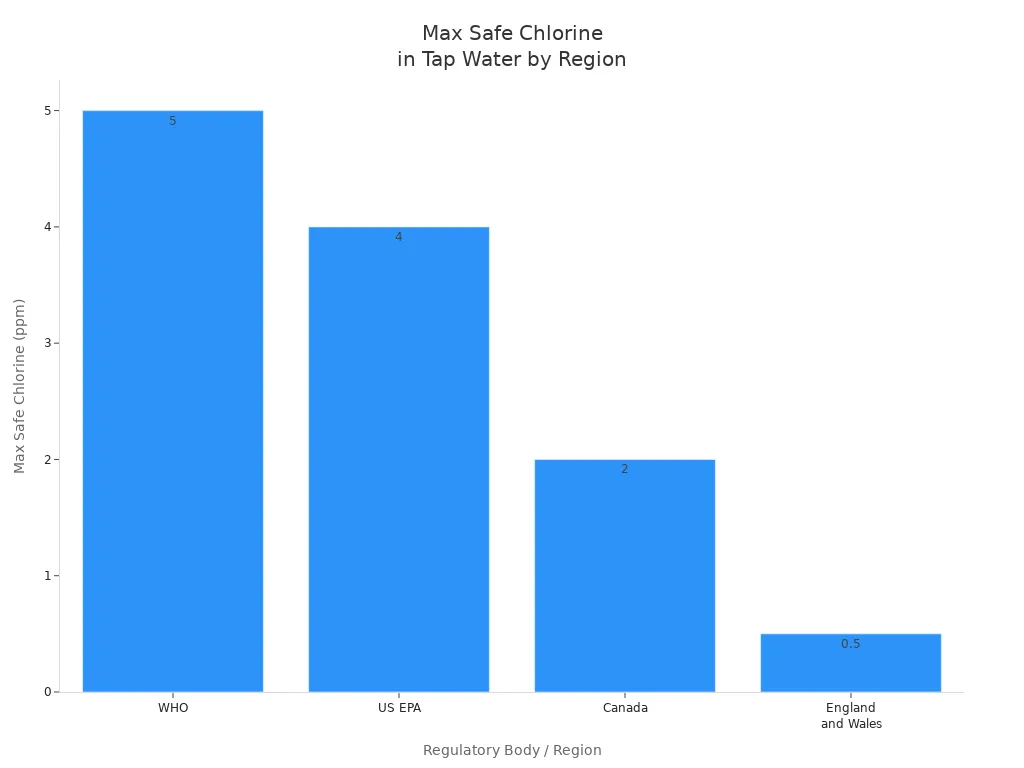
The EPA says the maximum safe chlorine level in drinking water is 4 ppm. WHO allows up to 5 ppm. These limits keep me safe from germs but also help avoid bad taste or odor. My water utility must test and report chlorine levels regularly. If they go over the limit, I get notified quickly.
Chlorine ppm in drinking water changes a lot depending on where I am. Here’s what I’ve learned:
Typical chlorine levels in tap water range from 0.2 to 5 mg/L worldwide.
Brazil allows 0.2 to 5 mg/L to ensure safety.
Most places aim for 0.5 to 1.5 mg/L at the tap.
Factors like water temperature, organic matter, and how far water travels affect chlorine ppm.
Some cities use higher doses at the plant (up to 3 mg/L) to make sure enough chlorine remains after long distribution.
Public water systems adjust chlorine and chloramine levels based on source water, treatment methods, and even weather. Private wells can have different risks and need regular testing.
I see “ppm” on water reports all the time. It stands for “parts per million.” In drinking water, 1 ppm means 1 milligram of chlorine in 1 liter of water. This unit helps me understand trace amounts that matter for safety. To calculate ppm, I divide the amount of chlorine by the total water volume, then multiply by one million. For example, 5 mg of chlorine in 1 liter equals 5 ppm. This makes it easy to compare chlorine levels and check if my water is safe.
Chlorine levels in tap water don’t stay the same everywhere or all year. Here’s why:
Local water source: Surface water needs more chlorine than groundwater because it has more bacteria.
Bacterial levels: More germs mean more chlorine is needed for disinfection.
Seasonal changes: Warm weather in spring and summer boosts bacterial growth, so utilities add more chlorine.
Water system maintenance: Repairs, flushing, and changes in pipes can change chlorine and chloramine levels.
Other factors like rainfall, drought, and even daily water use patterns affect chlorine ppm. My water might taste different after a big storm or during hot months.
The type of water source matters a lot. Surface water, like lakes and rivers, usually has more organic matter and bacteria. This means my utility adds more chlorine to keep drinking water safe. Groundwater often needs less chlorine because it’s cleaner.
If my water source has lots of bacteria, the treatment plant increases the amount of chlorine. This ensures effective disinfection and keeps my drinking water safe from disease.
I notice my water sometimes tastes different in summer. That’s because higher temperatures speed up bacterial growth and chlorine decay. Utilities boost chlorine and chloramine levels during these months to keep up with demand.
When my city does pipe repairs or flushes the system, chlorine levels can spike or drop. Maintenance activities stir up old water and change how much chlorine is needed. Sometimes, I get a notice if there’s a big change in water quality.
I often see both “free chlorine” and “total chlorine” on water test kits. Free chlorine is the part that’s still active and can kill germs. Total chlorine is free chlorine plus combined chlorine (like chloramines), which forms when chlorine reacts with other stuff in the water. Combined chlorine isn’t as good at disinfection and can cause bad smells or tastes.
Testing both helps me know if my water is safe. If free chlorine is too low, germs might survive. If total chlorine is high but free chlorine is low, I might have too many byproducts.
Free chlorine is the active part that disinfects my drinking water. It’s made up of hypochlorous acid and hypochlorite ions. These forms kill bacteria and viruses quickly.
Total chlorine is the sum of free chlorine and combined chlorine (like chloramines). Combined chlorine forms when free chlorine reacts with ammonia or organic matter. It’s less effective for disinfection but lasts longer in the system.
Knowing the difference helps me understand water safety. Free chlorine keeps my water safe from germs. Total chlorine tells me if there are byproducts or if the system needs adjustment. If I want to remove chlorine, I need to know which type I’m dealing with, since some filters work better on free chlorine than on chloramine.
High chlorine levels in drinking water can cause more than just a bad taste. Studies show that byproducts like trihalomethanes (THMs) increase the risk of bladder and colorectal cancer. Even at levels below current U.S. and EU limits, these risks exist. Animal studies confirm that some byproducts are genotoxic and carcinogenic. For people sensitive to chemicals, high chlorine and chloramine levels can cause skin, eye, or respiratory irritation. I use a water purifier or water filter for chlorine reduction if I notice strong chlorine taste or smell.
Aspect | Details |
|---|---|
Health Risks | 33% increased risk of bladder cancer; 15% increased risk of colorectal cancer linked to THMs |
Chemical Byproducts | Chloroform, bromoform, bromodichloromethane, chlorodibromomethane |
Exposure Levels | Increased cancer risks at THM levels as low as 40 ppb |
Recommendations | Use filtration methods (granulated activated carbon, reverse osmosis) for higher-risk individuals |
Low chlorine levels are just as risky. Without enough chlorine residual, bacteria can grow in the pipes. This can lead to outbreaks of waterborne diseases like gastroenteritis. Studies in Europe show that when disinfectant levels drop, cases of stomach illness rise. The EPA requires utilities to keep a minimum chlorine residual to prevent these problems. If I ever hear about low chlorine in my area, I know to be extra careful with my drinking water.
Chlorine residuals in tap water inactivate microbes that enter after treatment.
Low chlorine can lead to microbial intrusion and increase the risk of acute gastrointestinal illnesses.
Monitoring for bacteria like E. coli helps utilities catch problems early.
I’ve tried at-home test strips and color disk kits to check chlorine in tap water. These kits are cheap and easy to use. I dip a strip in water, wait a few seconds, and compare the color to a chart. Color disk kits use reagents for a more precise reading. But I’ve learned these DIY kits aren’t always accurate. They’re good for a quick check, but for exact results, I send a sample to a certified lab. Mail-in tests cost more and take longer, but they give me peace of mind about my drinking water.
At-home test strips and color disk kits are affordable and fast.
Results can vary and may not be precise.
Mail-in lab tests are more accurate but cost more and take longer.
Always be cautious of exaggerated claims from home test kit sellers.
Water utilities use professional digital meters and sensors to monitor chlorine and chloramine levels. These devices give continuous, accurate readings. Utilities test water daily, sometimes even more often during peak times. I can’t do this at home, so I rely on my utility’s Consumer Confidence Report for official results. If I want to know more, I can always ask for a copy of their latest water quality report.
I’ve tried several ways to remove chlorine from my drinking water. Some work better than others.
Method | Removal Rate | Key Details |
|---|---|---|
Activated Carbon Filter | Up to 95% | Removes chlorine and organic contaminants; improves taste and odor. |
Reverse Osmosis (RO) | Nearly 100% | Removes almost all chlorine and impurities; uses a semi-permeable membrane. |
Boiling | 30-50% | Drives off chlorine gas; needs about 20 minutes to be effective. |
Standing Water | N/A (natural dissipation) | Chlorine dissipates over 12-24 hours; works for low levels. |
Water Softener | N/A | Adsorbs chlorine; also softens water. |
Ultraviolet Sterilizer | Converts chlorine to harmless chloride ions | Breaks chemical bonds; used in high purity scenarios. |
Chemical Neutralizers | Rapid and complete | Vitamin C and sodium thiosulfate neutralize chlorine quickly. |
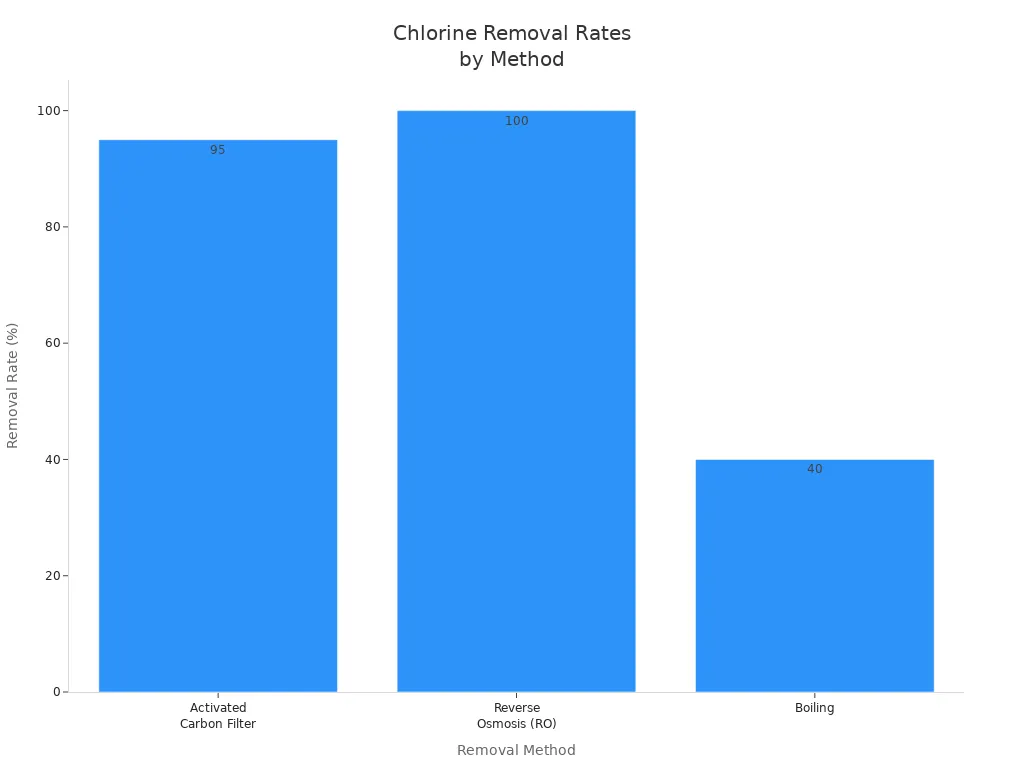
Activated carbon filters can remove up to 99% of chlorine and chloramine, making water taste and smell better.
Reverse osmosis systems also remove nearly all chlorine, but they need a carbon filter to protect the membrane.
Boiling water for 20 minutes can reduce chlorine, but it’s not practical for large amounts and doesn’t remove byproducts.
Chemical neutralizers like sodium thiosulfate or vitamin C work fast and leave no harmful residue.
UV light treatment kills germs but doesn’t remove chlorine or chloramine.
Distillation removes many impurities but isn’t reliable for chlorine.
If I want to improve my drinking water quality, I use a water purifier with activated carbon or reverse osmosis. These methods are the most effective for chlorine and chloramine removal.
Chloramine is a mix of chlorine and ammonia. My city sometimes uses it instead of chlorine for disinfection. Chloramine is weaker than chlorine but lasts longer in the pipes. It’s less likely to form regulated byproducts like THMs, but it can create other chemicals, such as nitrosamines, which may be harmful.
Aspect | Chloramine | Chlorine |
|---|---|---|
Chemical Nature | Combination of chlorine and ammonia (mainly monochloramine) | Pure chlorine |
Disinfection Effectiveness | Weaker; less effective against some pathogens | Stronger and faster acting |
Stability and Longevity | More stable; lasts longer in pipes | Less stable; dissipates quickly |
Disinfection Byproducts | Fewer regulated DBPs, but can form nitrosamines | More THMs and HAAs, linked to health risks |
Health Impact | Can irritate eyes, skin, and lungs in sensitive people | Can cause respiratory irritation |
Taste and Odor | Milder taste and odor | Strong chemical taste and odor |
Chloramine and chlorine both disinfect drinking water, but they have different effects. Chloramine is less powerful but sticks around longer, which helps keep water safe during long trips through pipes. Chlorine acts fast but fades quickly. Chloramine forms fewer regulated byproducts, but some of its byproducts may be toxic. Both are generally safe at the levels used in municipal water, but sensitive people may notice irritation or taste changes.
If my tap water uses chloramine, I notice a milder taste and fewer odors. But it’s harder to remove than chlorine. Boiling or letting water stand won’t work. I need a catalytic activated carbon water purifier to get rid of chloramine. Chloramine can also corrode pipes and damage rubber seals in appliances. If I have lead pipes, chloramine may increase lead leaching if corrosion control isn’t managed well. I always check my water quality report to see which disinfectant my city uses.
Implication Category | Details |
|---|---|
Disinfection Effectiveness | Chloramine is weaker but lasts longer in pipes. |
Disinfection Byproducts (DBPs) | Forms different byproducts, some may be toxic. |
Lead and Metal Leaching | Can increase lead leaching if pipes are old or corrosion control is poor. |
Aesthetic Issues | Harder to remove by boiling or aeration; may cause taste/odor problems. |
Plumbing and Appliances | Can corrode copper pipes and degrade rubber/plastic parts. |
Removal Methods | Catalytic activated carbon filters are best for chloramine removal. |
Tip: If you’re sensitive to chlorine and chloramine, use a certified water purifier with activated carbon or reverse osmosis for the best results.
Why does my water sometimes taste or smell like a pool?
That’s usually from high chlorine or chloramine levels, especially after maintenance or during hot weather.
Is it safe to drink water with chlorine?
Yes, as long as it’s within EPA and WHO limits. If you’re worried about taste or health, use a water purifier.
How can I tell if my water has chloramine?
Check your local water quality report or call your utility. Chloramine is harder to remove, so you’ll need a special filter.
What’s the best way to remove chlorine and chloramine?
Use a water purifier with activated carbon or reverse osmosis. These methods are proven to work for both disinfectants.
Can I use boiling to remove chlorine?
Boiling helps, but it’s not very effective and doesn’t work for chloramine.
I’ve learned that chlorine levels in drinking water usually stay within safe limits, but taste and health effects can vary. If you want to know what’s in your water, check your local utility’s Consumer Confidence Report. It lists chlorine levels and explains safety standards. For extra peace of mind, I use a certified water purifier—look for NSF or IAPMO certification. These filters really help if you’re sensitive to chlorine in drinking water.
Review your water utility’s Consumer Confidence Report each year.
Choose a certified water purifier for reliable chlorine reduction.
Avoid pool test kits for drinking water testing.
Tip: Certified filters improve both taste and safety for your home’s water.
I check my local water quality report for chlorine ppm. Sometimes, I use a home test kit. My city’s report tells me about chlorine levels, chloramine, and other impurities. If I want more details, I call my water utility.
Yes, high chlorine levels can cause taste and odor problems. Some people notice skin or eye irritation. Long-term exposure to byproducts may increase health risks. I use a water purifier or water filter for chlorine reduction to help remove chlorine and improve water safety.
I use a water purifier with activated carbon or reverse osmosis. These methods work well for both chlorine and chloramine. Boiling or letting water stand does not remove chloramine. Certified filtration systems give me peace of mind about water quality.
Chlorine levels change because of temperature, bacteria, and system maintenance. In summer, higher temperatures mean more bacteria, so utilities add more chlorine for effective disinfection. Sometimes, repairs or flushing can also change the amount of chlorine in tap water.
Yes! Water filtration removes impurities like chlorine, chloramine, and particles. Water purification goes further, targeting bacteria, viruses, and other health risks. I use both for the best drinking water quality and safety.