
Views: 0 Author: Site Editor Publish Time: 2025-08-14 Origin: Site


When people ask if a water purifier works, I say it depends. The answer depends on the technology and what is in your water. Not every water filter or purifier can remove all germs or chemicals. I use a water purifier at home. I care about my health and my water quality. Many people do the same thing. They do it for health, the environment, or because they do not trust tap water.
In 2022, about 77% of American homes used water filters. Most people used them because of:
Health worries
Concerns about water quality
Wanting to use less plastic
I check my water quality before I pick a purifier. City and country homes need different solutions. This is because their water sources and risks are not the same.
Water purifiers work best when you match them to your water. You should test your water first. This helps you choose the right filter for your needs.
Different filters take out different things from water. Basic filters make water taste better. Advanced filters like reverse osmosis and UV kill germs. They also remove heavy metals.
No single filter can remove everything bad from water. Using more than one method works better. Checking for certifications helps keep water safe.
You need to take care of your purifier often. Change the filter on time. This keeps the purifier working well and keeps you healthy.
Purified water is safe and healthy for most people. It gives you more control over water quality than spring water.
When I started learning about water filters, I wanted to know how they work. I found out that not all filters do the same thing. Some make water taste better. Others remove germs and chemicals that can be dangerous. So, how does a water filter work? I will explain it in a simple way.
Basic water filtration traps things you do not want in your water. Here is what happens in most water filtration systems:
Sediment filters are the first step. They catch dirt, sand, and small bits. This helps keep pipes and appliances safe.
Ceramic filters have tiny holes. They block particles and some germs. I like ceramic water purifiers because they stop many bad things.
Activated carbon filters help with taste and smell. They grab chemicals like chlorine and VOCs. This makes water taste fresh.
Physical barriers like sand, gravel, and mesh act like sieves. They catch bigger pieces and things you can see.
Pre-filters grab large debris before the main filter works. This helps the system last longer.
Tip: If you want better taste and cleaner water, use sediment and carbon filters.
Here is a table showing what different filters can do:
Filter Type | What It Removes | What It Misses |
|---|---|---|
Sediment | Dirt, sand, rust, silt | Chemicals, germs, dissolved solids |
Ceramic | Particles, some bacteria | Most viruses, chemicals |
Activated Carbon | Chlorine, VOCs, bad taste, some chemicals | Minerals, most germs, heavy metals |
Mechanical | Large debris, rust, sand | Dissolved solids, chemicals, microbes |
Most basic filters are good for daily use. But they do not catch everything. For example, pitcher filters and fridge filters cannot remove viruses or heavy metals. That is why I check my water before I pick a filter.
If you want more safety, you can use advanced water purification. These methods remove smaller and more dangerous things.
Reverse osmosis (RO) uses a special membrane. It removes up to 99% of bad stuff like heavy metals, nitrates, pesticides, and some germs. RO systems need pre-filtration and can waste water. But they protect well.
UV water purifiers use ultraviolet light to kill germs. The UV lamp shines at a certain wavelength. It destroys germs’ DNA. This method does not add chemicals or change taste. UV does not remove particles or chemicals. So, water must be clear first.
Ultrafiltration and microfiltration use membranes with different pore sizes. They remove bacteria, parasites, and some viruses. But they do not remove salts or chemicals.
Combined systems use mechanical, chemical, and UV methods together. They protect against viruses and heavy metals. But they cost more and need care.
Water purifying tablets are good for travel or emergencies. They use chemicals like iodine or chlorine to kill germs. I use them when I camp. They do not remove dirt or chemicals and may leave a taste.
Boiling water is an old method. Boiling kills most germs. But it does not remove chemicals or heavy metals. I boil water if I worry about germs. But it does not fix chemical problems.
Here is a table comparing how different filters and purifiers work:
Filter Type | Contaminants Removed | Limitations / Not Removed |
|---|---|---|
Reverse Osmosis | Up to 99% of heavy metals, nitrates, pesticides, microbes | Hydrogen sulfide, high iron |
Distillers | Minerals, metals, microorganisms | Slow, uses lots of energy |
Carbon Filters | Chlorine, VOCs, pesticides, PFAS | Fluoride, nitrates, bacteria, minerals |
UV Filters | 99.9% bacteria and viruses | Chemicals, metals |
Ion Exchange | Hardness minerals, some metals | Pathogens, sediment, chemicals |
Mechanical Filters | Dirt, rust, sand, silt | Dissolved solids, metals, chemicals, microbes |
Ultrafiltration | Bacteria, parasites, mold, sediment | Viruses, dissolved minerals |
Note: No single filter removes everything. Many systems use more than one method for better results.
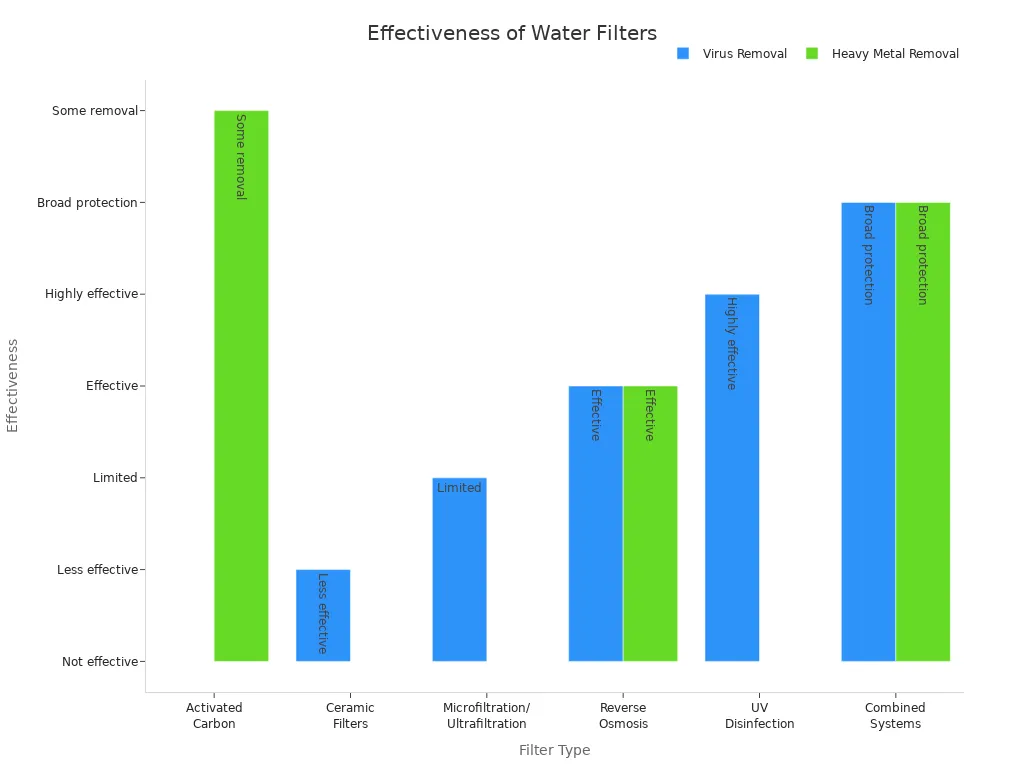
I also watch for new technology. Nanotechnology, advanced membranes, and solar-powered systems can remove more bad stuff with less energy. These new systems work better than old sediment filters and chemical treatments. They are good for tough problems like viruses and heavy metals.
When I pick a water filtration system, I ask what I need to remove. If I worry about germs, I choose a UV water purifier or a ceramic water purifier. If I travel, I use water purifying tablets. At home, I use more than one filter for the best safety. I learned that water filters work best when you match them to your needs.
When I learned about carbon water filters, I thought of a sponge. It has many tiny holes. An activated carbon filter grabs chemicals and holds them in its pores. This is called adsorption. It helps take out chlorine, VOCs, and bad smells from water. My water tasted better after I used one. These filters also lower some heavy metals, like lead, and even radon gas. But activated carbon filters do not remove microbes, fluoride, or hardness minerals. I use them to make water taste better and get rid of odors. If you want a water purifier for kitchen sink use, this filter is great for daily drinking water.
Tip: Change your activated carbon filter often. When it gets full, it does not work well.
Reverse osmosis (RO) is what I use for tough contaminants. This purifier uses a special membrane to block dissolved salts, metals, and some pesticides. I checked the facts: RO filters remove over 96% of lead and up to 99% of arsenic. They also work well for PFAS, which many people worry about. If you want a water purifier that removes fluoride, RO is the best choice. I use RO when I want the cleanest water, but it wastes some water and needs regular filter changes.
Contaminant | Typical Rejection Percentage |
|---|---|
Lead | 96-98% |
Arsenic | 94-96% |
I tried alkaline water filters to see if they help. These filters make water less acidic by raising the pH. Some people say alkaline water filters help with hydration and acid reflux. I read that athletes sometimes use them for recovery. But I learned that alkaline water purifiers do not remove many contaminants. They mostly change the water’s pH and add minerals. If you want a survival water purifier or a backpacking water purifier, I would not pick an alkaline filter. I use them only when I want to try new tastes or experiment.
Possible benefits: better hydration, antioxidant effects, relief from acid reflux.
Risks: may not remove contaminants, could cause problems for people with kidney issues.
I like using water filter pitchers at home and bottles when I travel. These filters are easy to use and do not need to be installed. I checked different pitcher models, like Brita and ZeroWater. Some water filter pitchers remove lead, chlorine, and even PFAS. But not all pitcher filters work the same. Certification is important. Most pitchers do not remove microplastics or all heavy metals. I use pitcher filters for quick, tasty water, but I do not use them for every contaminant.
Pitcher Model | Certified Contaminant Removal |
|---|---|
Brita Denali with Elite filter | Lead, Chlorine, PFAS |
ZeroWater Ready-Pour ZD-010RP | Lead, Chlorine, PFAS |
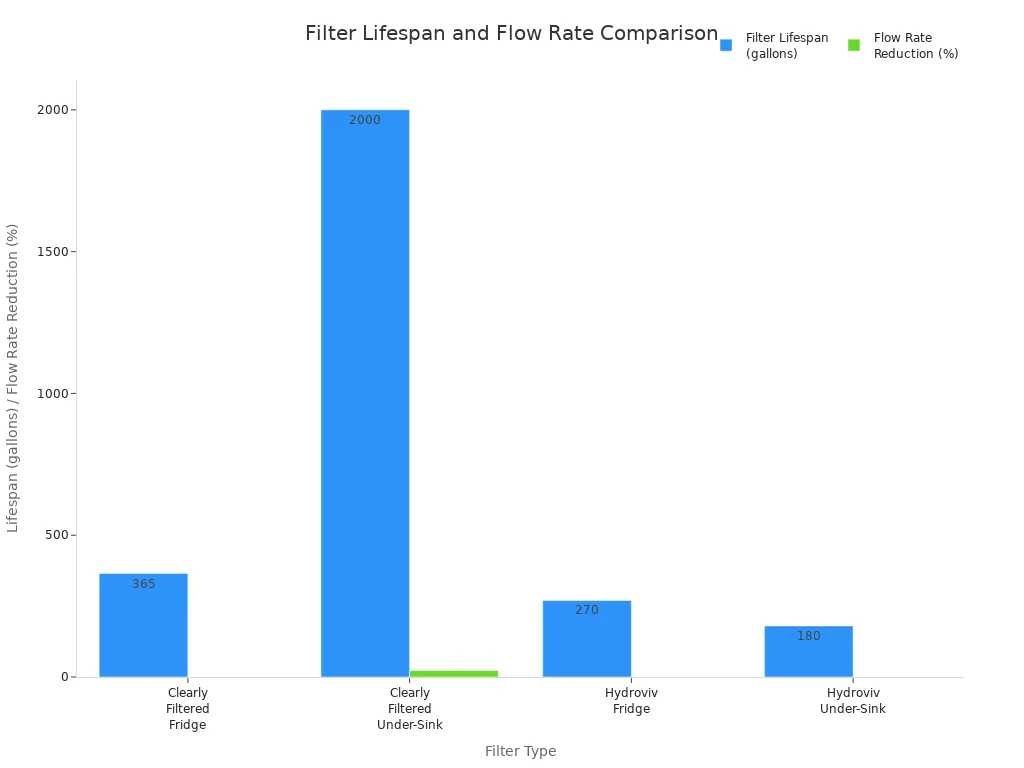
Refrigerator and faucet filters make it easy to get filtered water. I use a fridge filter for cold water and a faucet filter for cooking. These filters target lead, chlorine, PFAS, and VOCs. Some models, like Clearly Filtered, remove over 200 contaminants. Under-sink filters last longer and keep a good flow rate. I always check for NSF certification to make sure my filter works. Compared to drinking water filters like pitchers, fridge and faucet filters often remove more contaminants and last longer.
Hard water leaves spots and scale on dishes and appliances. I use a water purifier with ion exchange to fix this. Ion exchange filters swap calcium and magnesium for sodium. This helps stop scale. Traditional water softeners work the same way. Salt-free systems condition water to stop scale but do not remove minerals. For a whole house, I pick a system that treats all the water. If I need a quick fix, I soak things in vinegar. For long-term results, I use ion exchange or get professional treatment.
Treatment Method | Effectiveness | Maintenance | Cost |
|---|---|---|---|
Ion Exchange | Highly effective at removing calcium and magnesium ions | Regular salt refills | Moderate to High |
Salt-Free Systems | Prevent scale, do not remove minerals | Maintenance-free | Moderate |
DIY Methods | Temporary, not permanent | Minimal | Low |
Note: If you want a water purifier for kitchen sink use or a survival water purifier, check what contaminants you need to remove. Not all filters work for every problem.
When I first used a water purifier, I wanted to know what it could take out. I found out that most home systems focus on a few main things. These things can change how water tastes, smells, and how safe it is. After testing and reading about filters, here is what I learned:
Chlorine: Most tap water has chlorine. It helps stop bacteria and other germs. But it can make water taste and smell bad. My carbon filter lowered chlorine, and I noticed the change.
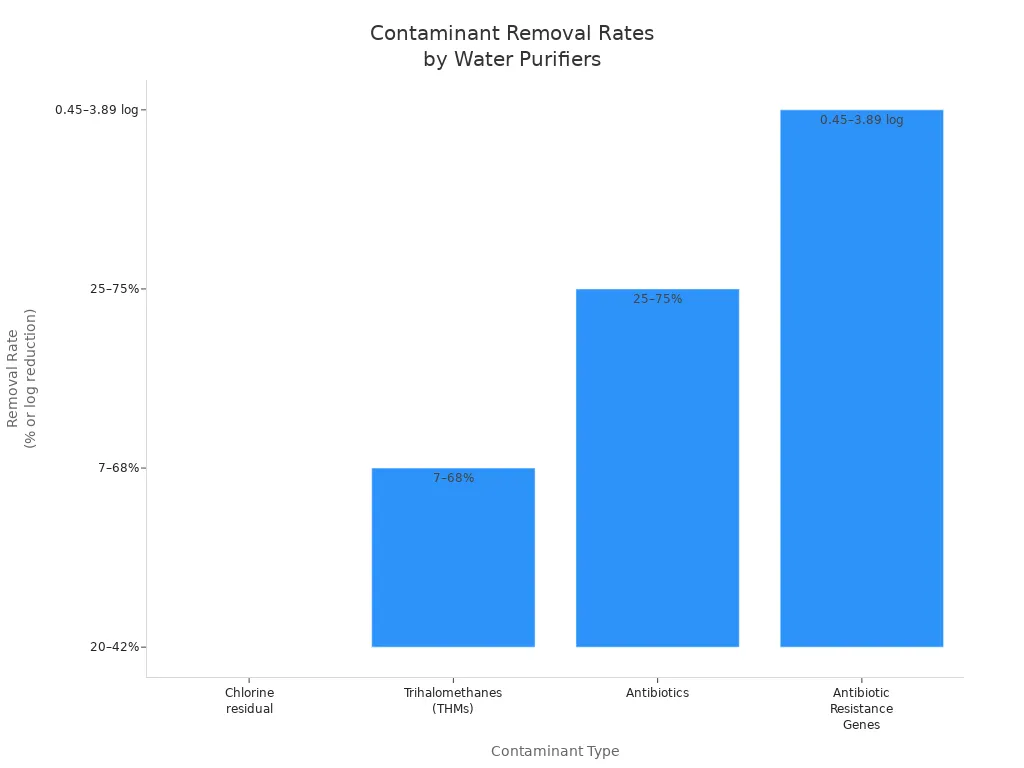
Trihalomethanes (THMs): These come from cleaning water. Some purifiers can lower THMs, but how much they remove is different. In my tests, trichloromethane dropped by about 37% on average.
Antibiotics and antibiotic resistance genes: Some filters can take out up to 75% of antibiotics. But not all filters work the same. I always check the product details before I trust a filter for this.
Turbidity, dissolved organic carbon (DOC), tastes, and odors: Most filters do well here. My filtered water always looks and tastes better.
Lead: I worry about lead, especially in old houses. Some filters remove it, but not every filter does. I always look for a filter that is certified for lead.
Bacteria: Many filters say they remove bacteria. I use a ceramic or UV filter when I want extra safety from bacteria and other germs.
PFAS: These are called “forever chemicals.” Some advanced filters, like reverse osmosis, can remove PFAS. I use an RO system if I want to get rid of these.
Pesticides: Some carbon filters and RO systems can lower pesticides. I check the product info to make sure.
Here is a table that shows how well different purifiers remove common contaminants:
Contaminant Type | Removal Rate / Efficiency | Notes |
|---|---|---|
Chlorine residual (total) | 20%–42% reduction | Most filters help, but not all chlorine is removed. |
Trihalomethanes (THMs) | 7%–68% removal | Removal depends on the filter and how long you use it. |
Antibiotics | 25%–75% removal | Some filters work better than others. |
Antibiotic Resistance Genes (ARGs) | 0.45 log to 3.89 log removal | Some filters may even increase ARGs, so I choose carefully. |
Turbidity, DOC, tastes, odors | Effectively removed | Most filters do well here. |
Lead | Varies | Always check for certification. |
Bacteria | Varies | Use ceramic or UV filters for best results. |
Tip: If you want to remove something special, always check if your filter is certified for it. Not all filters remove everything.
People often ask, “Do water purifiers remove fluoride?” I found out that most regular filters do not. If you want to remove fluoride, you need a reverse osmosis system or a special filter for fluoride. I use RO when I want to lower fluoride in my water.
Even the best water purifier cannot remove everything. I learned this when I thought my filtered water was perfect. Some things still get through, and some filters cannot handle certain stuff. Here is what I found out:
Chloramine: My normal carbon filter did not remove chloramine. I needed a catalytic carbon filter for that.
Lead and arsenic: Not every filter removes lead or arsenic. I always check for NSF certification if I am worried about these.
Rocket fuel and other chemical contaminants: Most regular filters do not remove these. I look for advanced systems if I am worried about chemicals.
Fecal waste and some pathogens: Regular filters may not remove all bacteria, viruses, or fecal waste. I use UV or ceramic filters for extra safety.
Chemical by-products from water treatment: Some by-products stay in the water even after filtering. I learned these can cause health problems over time.
Here is a table that shows what standard water purifiers might miss and why it matters:
Contaminant | Removal by Standard Water Purifiers | Potential Health Risks |
|---|---|---|
Chloramine | Not removed by standard carbon filters | Harmful to circulatory and respiratory systems |
Chlorine | Not all byproducts removed | Neurological and respiratory harm; cancer risk |
Lead | May not be fully removed | Developmental problems, cancer, neurological harm |
Arsenic | May not be removed | Cancer, developmental problems |
Rocket fuel (chemicals) | Not typically removed | Toxic effects |
Fecal waste | Not always removed | Gastrointestinal illness, nausea, stomach pain |
Chemical by-products | Often not fully removed | Cancer, neurological, respiratory, circulatory harm |
People also ask, “Is purified water bad for you?” I found that purified water is safe for most people. Sometimes it can taste flat because minerals are gone. If you have health problems, like kidney issues, talk to your doctor before drinking only purified water.
Note: No filter removes every contaminant. I always pick my filter based on what is in my water. If I worry about viruses or bacteria, I use UV or ceramic filters. For lead or pesticides, I pick a filter that is certified for those.
Filtered water makes me feel safer, but I never think it is perfect. I test my water and keep learning about new risks. This helps me protect my family from contamination.
When I think about water purifiers, I always start with health. Clean water is key for my family’s well-being. Certified filters help remove bacteria, lead, and other harmful stuff. The EPA sets strict rules for water quality, and certified filters meet these standards. I look for NSF/ANSI 53 certification because it means the filter has been tested for health-related contaminants like lead, mercury, and VOCs. UL Solutions and other labs check if filters really work. I trust filters that pass these tests.
I get a lot of questions about safety. Can you drink purified water? Yes, you can. Purified water is safe for most people. Some ask if distilled or purified water is best for baby formula. I use purified water for baby formula because it removes bacteria and chemicals. For CPAP machines, I use purified water to stop bacteria from growing in the machine. People also ask, is spring water better than purified water? Spring water can taste good, but it may still have bacteria or minerals. Purified water gives me more control over quality and safety. I use filters to improve health and peace of mind.
I always check the cost before I buy a system. Reverse osmosis systems can cost from $150 to $4,800. Installation adds more. I spend about $400 a year on maintenance. Filters need regular changes. Most water filter pitchers last 1-2 months. Under-sink filters last 6-12 months. If I forget to change a filter, bacteria can grow, and water quality drops. I watch for slow flow or bad taste as signs to replace filters. Neglecting maintenance can damage appliances and make water unsafe.
Here’s a quick table to show costs for a reverse osmosis system:
Cost Component | Cost Range / Estimate |
|---|---|
Purchase Price (RO systems) | $150 to $4,800 |
Installation Cost | $150 to $1,500 |
Annual Maintenance | ~$400 per year |
RO Membrane Replacement | $50 to $100 every 3-5 years |
I always start by checking my local water quality. I read water reports or get my water tested. If I see bacteria or heavy metals, I pick a filter that targets those. For taste and odor, I use activated carbon filters or water filter pitchers. If I have a big family, I choose a system with a high flow rate. I also check maintenance needs and filter costs.
Here are my tips for picking the right filter:
Test your water to find out what’s in it.
Choose filters with NSF/ANSI 53 or 401 certification.
Don’t pick a filter just for price or fancy features.
Make sure you can keep up with filter changes.
For water filter pitchers, check if they remove lead, bacteria, and other key contaminants.
Tip: Never skip maintenance. Old filters can let bacteria and other contaminants back into your water.
I use water filter pitchers for daily drinking water. They are easy to use and good for taste. For more protection, I use a system with multiple filters. I always match my filter to my water quality and needs. That’s how I make sure my water is safe and healthy for everyone at home.
I found out that water purifiers and filters help a lot. They work well if I use and take care of them. Each filter fixes different water problems. I always pick the right filter for my water. Cleaning and changing filters often keeps water safe. I look at trusted places like Consumer Reports before I buy anything. Clean water helps my family stay healthy. That is why I always do research and keep up with maintenance.
People ask me this a lot. Purified water gets cleaned to remove bad stuff. Spring water comes from nature and has minerals. I pick purified water because it is safer. Spring water tastes different because of the minerals.
I drink purified water every day. Distilled water is good for things like irons or CPAP machines. Distilled water has no minerals, so it tastes plain. Purified water keeps some minerals and tastes better.
I choose purified water for health reasons. Spring water tastes fresh, but it can have germs or minerals. Purified water makes me feel safe. I always check where spring water comes from before I drink it.
Distilled water is made by boiling and catching steam. Purified water uses filters or chemicals to clean it. I use distilled water for medical things. For drinking, I like purified water because it tastes better.
I trust purified water more than spring water. Spring water has minerals, but it can have germs too. Purified water gets cleaned very well. I test my water if I use spring water.
Tip: Always read labels and test your water before you pick.


